
Volkswagen of Daphne
Is the 2027 Taos Sport Right for You? A Quick Trim Breakdown
The 2027 Volkswagen Taos Sport sits between the S and SE, giving buyers a styling-focused option with a starting MSRP of $27,400. It costs $900 more than the S and $1,890 less than the SE before destination and other applicable charges. Choose it if its appearance is worth the upgrade to you; compare the SE if cabin convenience features matter more.
Compare the Taos
Use the comparison below to narrow the choice in stages: understand the Sport's design, compare the nearby trims, then evaluate the cabin and drivetrain around your own driving. You do not need to prefer the most expensive version to make a considered choice. For some households, the useful result will be confirming that the S already covers the essentials. For others, seeing what changes inside the SE will explain why it deserves a test drive alongside the Sport.
The Taos Sport is an equipment version of Volkswagen's compact SUV. Its distinguishing features emphasize exterior detailing and seat design.
What Makes the 2027 Taos Sport Different?
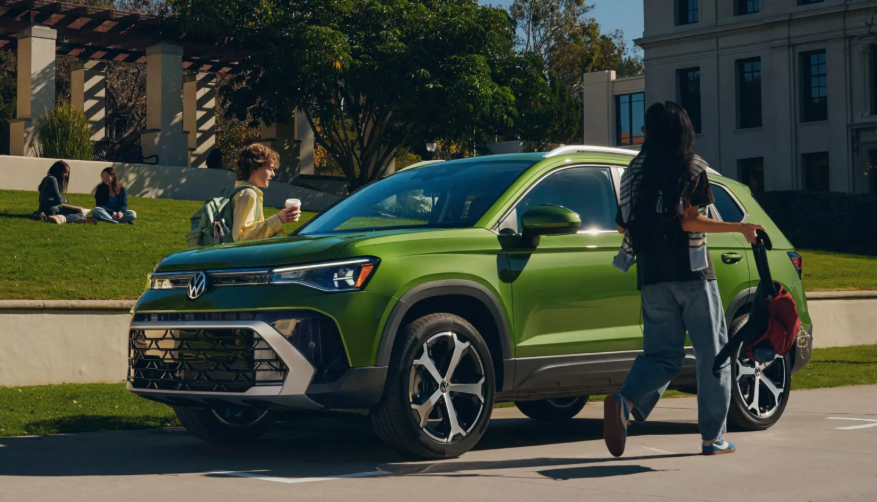
The 2027 Taos Sport combines 18-inch black alloy wheels with a dark grille, gunmetal bumper detailing, and gloss-black mirror caps and spoiler. Black and gray cloth upholstery with yellow stitching carries the theme into the cabin. Those details give buyers a coordinated appearance without requiring a move to the SE Black.
Look at the seats as well as the exterior when comparing vehicles. Photos can help you narrow your preference, but sitting in the cabin is a better way to judge whether you like the upholstery and overall presentation. Take a moment to compare both versions in similar lighting rather than deciding from different promotional photographs.
Judge the Whole Vehicle, Not One Detail
A wheel design can look appealing in a close-up photograph while making less difference to you when you see the entire vehicle. Walk around the Sport, then do the same with the S. Look from the front, the side, and the rear. Decide whether the combination feels noticeably different to you rather than trying to assign a dollar value to every individual piece of trim.
Body color belongs in that comparison too. Ask to see the color you are considering in person when possible. A photograph taken in shade can create a different impression from a vehicle parked in direct sunlight. If your preferred color is unavailable to view, use the photographs to narrow your options and reserve the final judgment until you can see a suitable example.
It also helps to identify what you would change about the S. If the honest answer is only that you prefer the Sport's wheels and detailing, the upgrade has a clear purpose. If you are hoping it will also transform the way the vehicle accelerates or add a particular convenience feature, put that expectation on a separate checklist. Styling photographs cannot establish either one.
Taos S vs Sport vs SE: Where Should You Spend?
Volkswagen lists these starting prices for the three versions closest to this decision. Compare the same drivetrain and review the complete equipment list on each vehicle before comparing final quotes.
| Trim | Starting MSRP | Selected highlights | Start here if... |
|---|---|---|---|
| S | $26,500 | Turbo engine, IQ.DRIVE, VW Digital Cockpit | You want the lowest starting price. |
| Sport | $27,400 | Black wheels, dark exterior details, yellow seat stitching | The appearance upgrade is your priority. |
| SE | $29,290 | Dual-zone Climatronic, CloudTex and cloth seats, front and rear Park Distance Control | Cabin convenience and parking assistance matter more. |
Starting MSRPs exclude destination, taxes, title, options, and other applicable charges. Selected highlights are not complete equipment lists. Actual vehicle pricing varies.
When the S Is Enough
Start with the least expensive version that meets your needs. Make a short list of features you would genuinely miss, then check whether the S already satisfies it. If you like its appearance and the equipment works for your routine, there is no need to move up simply because another version sits above it.
When the Sport Is Worth the Difference
The Sport is worth considering when its design is something you actively prefer. Ask yourself whether you would still choose it after seeing the S beside it. That is a more useful test than treating every additional feature as automatically worth paying for.
When to Compare the SE
If you and a passenger prefer different cabin temperatures, try the SE's separate climate settings. If parking support is important, ask for a demonstration of its parking sensors. Testing those functions makes it easier to decide whether they deserve more of your budget than exterior details.
For a 2027 Taos buyer deciding between Sport and SE, the strongest comparison is appearance versus the convenience features the household will actually use. Choose Sport when its design is the reason to upgrade; compare SE when its cabin and parking equipment solves a recurring need. If neither difference matters much, keep the S on your shortlist.
Compare the Cabin Around Your Actual Routine
Equipment lists are easiest to interpret when you connect each item to a task. Before looking at another trim, describe one normal weekday: who drives, who rides along, what comes with you, and where you park. That gives the comparison a purpose. A feature that solves an everyday inconvenience deserves closer attention than one that sounds attractive but has no clear role in your routine.
Start With the Driving Position
Adjust the seat and steering wheel before judging the cabin. Settle into the position you would use for a longer trip, then check whether you can comfortably see the displays and reach the controls you expect to use. Spend a few minutes there instead of moving immediately to the next vehicle. A comfortable first impression is useful, but it should survive more than a quick sit.
If two people will share the Taos, have both make their own adjustments. Take turns moving between your preferred positions and notice how easy the process feels. Do not assume the other driver values the same things. One may care most about the seating surface, while the other may place greater value on control placement or the view from the driver's seat.
Try the Climate Controls Together
To evaluate the SE's dual-zone setup, sit in the front seats with the person who usually travels beside you. Set different preferred temperatures and try the controls. The question is whether separate settings address something that actually happens in your car. If you normally agree on a cabin setting, this feature may have less influence on your decision than it would for another household.
Also check how you make an adjustment while seated normally. Locate the settings before the drive, and ask questions while parked. You do not need to master every menu during a dealership visit. You do need enough familiarity to decide whether the arrangement feels clear and comfortable to use, especially if you are changing from a vehicle with a very different dashboard.
Include Rear Passengers and Everyday Cargo
If someone regularly rides in the back, let that person take part in the comparison. Set the front seat for the usual driver first, then check the space behind it. Otherwise, an artificially forward driving position can give you an unhelpful impression of the room your passenger will actually have. Include the person and seating position that reflect your normal use.
Try the items that are awkward in your current vehicle. That might be a folded stroller, a work bag that needs to stay upright, or the luggage you use for regular weekend travel. Check the opening and loading process as well as whether the items fit. A successful test is one you can repeat comfortably, rather than a carefully arranged setup you would not want to recreate every morning.
Demonstrate Parking Features Before Assigning Value
Ask how the SE's Park Distance Control communicates with the driver and have the operation explained in an appropriate demonstration. Consider whether that type of assistance addresses your parking routine. Someone using a tight garage may give it a different priority from a shopper who usually parks in an open driveway. Either preference can be reasonable; the value depends on the task.
Does the Sport Have More Power?
No. The S, Sport, and SE share a 174-hp, 1.5-liter turbocharged engine and an eight-speed automatic transmission. Moving between these versions does not buy a higher horsepower rating.
During a test drive, focus on the driving position, pedal response, visibility, and how the transmission feels at the speeds you normally use. For a Daphne-to-Mobile commute, ask for a route that lets you evaluate more than a short loop around the dealership. If you often travel with passengers, check their seating comfort as part of the same visit.
Choose the Drivetrain Separately
The Sport is available with front-wheel drive or 4MOTION all-wheel drive. Its listed starting MSRP is $29,100 with 4MOTION, compared with $27,400 for front-wheel drive. The listed EPA combined estimates are 28 and 30 mpg, respectively; actual mileage varies.
Keep the drivetrain consistent when comparing trims so that you know what each price difference represents. You can also review the Volkswagen 4MOTION lineup if all-wheel drive is part of your shopping list.
Understand the Driver-Assistance Limitations
IQ.DRIVE is standard on the 2027 Taos. It provides driver assistance, and the driver must remain attentive and in control. Volkswagen identifies heavy rain, unclear lane markings, and blocked sensors among conditions that can limit system operation.
Ask for a demonstration of the controls and alerts before using the systems yourself. On a Bayway commute, changing weather and road markings make understanding those limitations more useful than simply recognizing a feature name.
Three Ways to Apply the Comparison on the Eastern Shore
The following are shopping examples, not claims about what local customers usually buy. Use the example closest to your routine to decide what you need to experience during a visit. You may recognize parts of more than one scenario, particularly if the Taos will serve as both a commuter vehicle and the household's weekend transportation.
A Regular Daphne-to-Mobile Commute
Suppose most of your driving time is spent traveling to work and back, with occasional passengers and relatively little cargo. Your comparison should give you time to judge the seat, visibility, control layout, and driving experience over a representative route. Looking at a vehicle in a parking space will not answer those questions as well as driving it.
Afterward, write down what you actually noticed. Were the controls easy to locate? Did you find a comfortable seating position? Was there anything you wanted to try again? Those observations help keep the trim decision connected to the time you will spend inside the car. They also give you specific questions to revisit rather than a vague impression that one version seemed nicer.
Local Errands With Frequent Passengers
Imagine a week built around appointments, shopping, and repeated short trips along US-98. Start with entry, exit, seating, and the objects that move in and out of the car with you. Have a frequent passenger join the visit if possible. Ask that person what feels comfortable and what needs another look instead of making every decision from the driver's seat.
Then revisit the features that initially attracted you to a higher trim. If they make those repeated tasks easier, you have a practical reason to consider them. If the difference is mostly visual, decide whether that preference still carries enough weight. The point is to give both appearance and daily use an honest place in the decision.
One Vehicle for Weekdays and Weekend Trips
If the Taos will also handle travel toward Gulf Shores or visits farther from home, evaluate the cabin with your usual passengers and travel bags in mind. Include the items you carry regularly before worrying about an unusual once-a-year load. A trim upgrade should not distract you from checking whether the vehicle itself suits the household's passenger and cargo needs.
Write two short lists: what needs to work on an ordinary Tuesday and what needs to work on a typical weekend away. A vehicle that handles both lists comfortably is a stronger candidate than one chosen around a single impressive feature. If the basic fit is wrong, comparing another trim will not resolve every concern.
Make the Comparison Useful Before You Visit
- Bring a must-have list. Separate essential equipment from features you would enjoy but can comfortably skip.
- Check the exact vehicle. Read its window sticker rather than assuming every advertised feature applies to every trim.
- Try your normal setup. Adjust the seat, check rear passenger space, and bring a frequently used stroller or bag if fit is important.
- Compare complete quotes. Keep drivetrain, options, and included charges clear so the lower headline number does not decide the comparison by itself.
Build a Comparison You Can Review at Home
For each candidate, record the model year, trim, drivetrain, identifying vehicle information, options, and quoted price. Add two personal notes: the feature you most want and the compromise you would be accepting. This keeps the review tied to actual vehicles. It also prevents a photograph or a remembered starting price from standing in for a configuration you have never compared directly.
Keep the notes short enough to read side by side. For example, one vehicle might be your preferred appearance choice, while another offers the cabin arrangement you liked more during the demonstration. Neither observation needs to become a universal judgment about the trim. You are documenting why each candidate belongs on your own shortlist.
Separate Vehicle Price From the Payment Discussion
Request a written breakdown that identifies the vehicle, included equipment, and applicable charges. If financing or leasing enters the conversation, review the proposed terms separately rather than letting one monthly figure replace the equipment comparison. This guide does not establish a payment, approval, or offer for a particular shopper. Those details require a current proposal based on the transaction being considered.
When two proposals differ, ask which differences come from the vehicle and which come from the transaction terms. If you are including a trade, make sure you can identify that part of the proposal too. Clear questions are more useful than trying to infer what a headline number includes. Keep a copy of the breakdown so you can revisit it without relying on memory.
Check the Details That Could Change Your Choice
Before making the final selection, return to the one or two features that matter most to you and confirm them on the vehicle being considered. Read the window sticker and ask for clarification wherever the equipment description is unclear. A broad model advertisement can help you discover a feature; the individual vehicle's equipment is what determines whether that feature is part of your purchase.
Then ask yourself what, if anything, you still need to experience. Perhaps the other driver has not sat in the car, your regular cargo has not been tried, or you have only seen one of the two interiors. Resolve that specific gap rather than restarting the entire comparison. A focused second look can make the final decision easier to explain and feel comfortable with.
Ask Each Driver to Make an Independent Shortlist
If the purchase is a shared decision, have each driver name a first choice before discussing it together. Include a reason and one unresolved question. This helps reveal whether you are choosing between different priorities or simply working from different information. A preference based on upholstery and a preference based on parking equipment can both be valid, but they need a more specific conversation than agreeing that one vehicle has more features.
Compare those notes after the demonstrations and test drive. If your first choices differ, try to identify the smallest additional check that would help: another look at the interior, a clearer equipment explanation, or time in the passenger seat. Keep the discussion focused on how you will share the car. You are looking for a choice both drivers understand, including the tradeoffs each person is accepting.
Key Takeaways
- Use your must-have list to decide whether an upgrade earns its place in the budget.
- The Sport emphasizes a coordinated appearance.
- Compare the SE when cabin convenience and parking equipment address daily needs.
- Trim choice and drivetrain choice deserve separate comparisons.
2027 Taos Sport FAQs
Is 4MOTION standard on the Taos Sport?
No. The Sport offers both front-wheel-drive and all-wheel-drive configurations.
Is Sport the same as SE Black?
No. They are separate trims. If both appeal to you visually, compare their full equipment lists and total prices rather than choosing by the dark exterior details alone.
Can I order a Sport based on the starting MSRP?
A starting MSRP is a reference for a base configuration. Request a quote for the drivetrain, options, and vehicle you want, including all applicable charges.
Compare Your Taos Options in Daphne
Bring your must-have list to Volkswagen of Daphne, and we can help you compare vehicle equipment and current availability. Start with the versions that meet your needs, then test whether the upgrade makes a difference you value.
View Current Volkswagen InventorySchedule a Test Drive