
Volkswagen of Daphne
Understand the Coverage Before Choosing a Certified Volkswagen
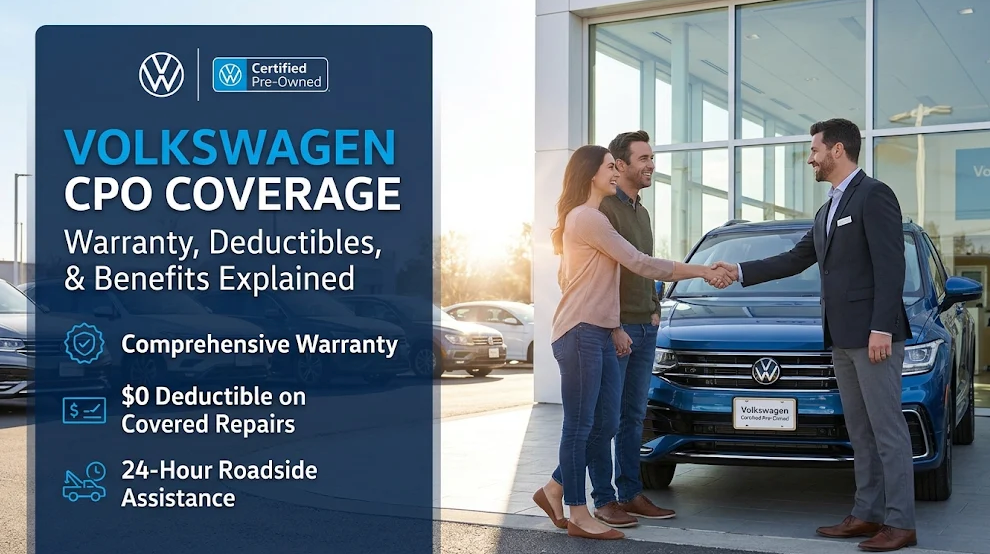
For model-year 2020 and newer Volkswagen Certified Pre-Owned vehicles purchased on or after April 1, 2026, Volkswagen lists an additional two years or 24,000 miles of CPO Limited Warranty coverage, whichever occurs first. Coverage starts when the New Vehicle Limited Warranty expires or on the CPO sale date, whichever is later. A $50 deductible applies per dealer visit for covered repairs, with exclusions and limitations explained in the applicable warranty manual.
Those terms are useful only when they are connected to the vehicle you are considering. A recently placed-in-service car may still have original warranty coverage remaining, while another certified car may begin its CPO warranty at purchase. Electric vehicles also have a separate high-voltage battery warranty that needs its own review.
Before comparing prices, establish the certification status, coverage timeline, inspection record, and costs that remain your responsibility. That gives you a clearer basis for deciding whether a particular certified vehicle fits your plans.
Volkswagen Certified Pre-Owned is a manufacturer program for qualifying used Volkswagen vehicles that complete its certification process. Program benefits include a CPO Limited Warranty, a 100+ point dealer inspection, and a CARFAX Vehicle History Report.
A Used Volkswagen Is Not Automatically Certified
A Volkswagen badge, low mileage, or a clean-looking interior does not establish CPO status. Confirm that the exact vehicle is being sold as Volkswagen Certified Pre-Owned and that the certification applies to its VIN. A general used-car listing or a description such as inspected is not a substitute for that confirmation.
The distinction matters because a non-certified vehicle may have a different warranty situation. It might have remaining original coverage, an optional service contract, or other written terms. Compare those actual documents rather than assuming that every used Volkswagen includes the manufacturer CPO program.
Ask for the Vehicle-Specific Certification Documents
Request the certification information and completed inspection checklist for the car you plan to buy. Check that the VIN matches the listing and purchase documents. If a different vehicle becomes the final candidate, repeat that check instead of carrying the first car's paperwork into the second transaction.
Age, mileage, history, equipment condition, and program requirements all belong in the eligibility review. Let the current certification process establish whether the vehicle qualifies. A model-year calculation alone cannot confirm that an individual car has completed certification or that a listed vehicle will qualify before delivery.
Use the Overview to Prepare Better Questions
The Volkswagen of Daphne CPO program overview provides additional context and inspection-checklist resources. Use it to identify the documents you want to see, then connect those documents to the actual vehicle. Program information and vehicle-specific confirmation serve different purposes, and both are useful during the purchase.
When Does the CPO Limited Warranty Begin?
The start date is one of the most important details to establish. The current program runs after the New Vehicle Limited Warranty expires, or from the CPO sale date if that original coverage has already ended. Purchasing a certified car does not restart its original new-vehicle warranty.
Volkswagen's warranty manual for CPO purchases on or after April 1, 2026 describes the additional coverage as two years or 24,000 miles for model-year 2020 and newer vehicles, whichever occurs first. Its start is tied to the later of original New Vehicle Limited Warranty expiration and the CPO sale date. Buyers should obtain the applicable start, expiration, and mileage limits for their VIN in writing rather than counting the advertised term from an assumed date.
| Vehicle at CPO purchase | How the start works | What to confirm |
|---|---|---|
| Original warranty remains active | Remaining original coverage continues before the CPO warranty begins. | Original in-service date and the applicable time and mileage expiration. |
| Original warranty has expired | The CPO warranty begins at the CPO sale date. | Delivery date, odometer, and the resulting CPO coverage limits. |
Whichever Occurs First Matters
A warranty with both time and mileage limits ends when the applicable limit is reached first. A driver who covers substantial annual mileage should therefore review more than the calendar date. Someone driving relatively little still needs to understand the time limit rather than assuming low mileage keeps coverage open indefinitely.
Do not treat the advertised CPO term as six fresh years of coverage beginning at your purchase, or assume that an original-warranty mileage limit resets. Ask for a written explanation of the actual vehicle's timeline. That is much more useful than adding program headlines together without checking their starting points.
As a simple planning example, 24,000 miles would take about 16 months to accumulate at 18,000 miles per year once the CPO period begins. At 8,000 miles per year, the two-year time limit would arrive before 24,000 additional miles under that assumption. These are illustrations of how two limits interact, not calculations of a specific car's expiration. Establish the actual starting date and odometer limits first, then use your expected driving to understand which boundary could matter sooner.
Earlier Purchases Need Their Own Terms
The current manual is identified for purchases on or after April 1, 2026. If you already own a Volkswagen bought under an earlier version of the CPO program, keep its original warranty documents and have those terms reviewed. A current shopping guide should not be used to rewrite an earlier purchase's coverage.
What the $50 Deductible Does and Does Not Mean
The published deductible applies to repairs covered by the CPO Limited Warranty. It is not a promise that every service visit, maintenance operation, or repair will cost only $50. The concern must be evaluated under the warranty's terms before the applicable customer responsibility can be determined.
The current manual also states that, when more than one repair attempt is necessary for the same covered manufacturing defect, the deductible for that repair is paid only once. Keep the repair orders if a concern requires another visit, and have the service department review the relationship to the earlier work.
Coverage Is Limited, Not an Unlimited Repair Budget
The CPO Limited Warranty addresses qualifying defects in the manufacturer's materials or workmanship, subject to its terms. It includes exclusions, so a component's presence on the vehicle does not automatically establish coverage for every condition affecting it. Ask how a specific concern is classified instead of relying on an informal phrase such as everything is covered.
Before approving work, request an explanation of the proposed service, coverage determination, deductible, and any charges outside the covered repair. If diagnosis or additional work is needed, ask how authorization will be handled. A clear estimate is more useful than assuming the program headline establishes the final invoice.
Routine Maintenance and Wear Still Need a Budget
The manual excludes scheduled maintenance and specifies wear items such as brake pads and wiper blades. Tires are not covered by this CPO Limited Warranty, although separate tire-manufacturer coverage may apply. These distinctions mean a certified purchase still requires planning for ordinary ownership expenses.
Review the maintenance schedule and available service history before buying. Ask which work was completed during certification and which maintenance will be due during your expected ownership. An inspection at purchase is useful information, but it does not turn future scheduled services into warranty repairs.
Read the Cause-Based Exclusions Carefully
The warranty also describes exclusions involving damage or malfunctions caused by matters such as lack of maintenance, misuse, certain modifications, accidents, and environmental conditions. Have a specific concern evaluated under the applicable wording rather than assuming every situation is treated identically. The documents and circumstances matter.
For a Gulf Coast vehicle, review the history and any available records concerning water or storm damage. CPO coverage should not be treated as a substitute for understanding a car's condition and history. Ask questions before purchase if the records or inspection leave an issue unexplained.
What the Inspection and CARFAX Report Add
Volkswagen's 100+ point dealer inspection covers areas including engine starting performance, transmission operation, brakes, steering, and maintenance needs. Ask to see the completed vehicle-specific checklist, not just a blank sample showing what the program generally examines.
A checklist explains what was assessed and recorded during certification. It does not promise that no component will ever need attention. Read it alongside the warranty terms: the inspection concerns the vehicle's certification review, while the warranty establishes the conditions for qualifying coverage.
History and Inspection Answer Different Questions
The CARFAX Vehicle History Report provides reported history information, while the inspection addresses the certification review of the vehicle. Neither should replace the other. If an entry raises a question, ask for clarification and any supporting documentation rather than assuming the certification label supplies an explanation.
Look for consistency among the VIN, odometer information, maintenance records, and completed paperwork. If a document refers to another vehicle or an important detail is missing, resolve that discrepancy before proceeding. Keeping the paperwork aligned is a practical purchase check, not an expectation that buyers perform the certification themselves.
Use the Test Drive for Your Own Fit Questions
Certification does not decide whether you like the seat, controls, cargo access, or driving position. Use the visit to test the tasks that matter to your household. A car can meet the program requirements and still be the wrong size or equipment combination for your routine.
What Changes When the CPO Volkswagen Is Electric?
Separate the CPO Limited Warranty from the High-Voltage Battery Limited Warranty. The current April 2026 manual lists the CPO term for model-year 2020 and newer vehicles without the separate longer EVCPO term found in an earlier program manual. An earlier electric-vehicle purchase should be checked against its applicable documents.
For model-year 2021 and newer electric Volkswagens sold certified pre-owned, the current manual describes the high-voltage battery term as eight years or 100,000 miles, beginning at the original in-service date. That clock does not restart when a second owner purchases the vehicle as CPO.
Battery Coverage Is Not a New-Battery Promise
Volkswagen's published battery information includes a net-capacity threshold of at least 70 percent under its warranty terms. Qualifying capacity repairs may restore the battery to that level rather than to an as-new 100 percent. Do not translate battery warranty coverage into a promise of a new battery or a particular driving range.
Ask for the battery-related information supplied with the certification inspection and have the remaining warranty reviewed using the original in-service date and current mileage. The dealership's program overview identifies a Battery Health Status report for electric vehicles. Review the report for the actual candidate rather than relying on a generic description.
Evaluate Charging Separately From Warranty Coverage
Check whether charging fits your home and travel routine before deciding that the coverage makes an EV the right choice. Confirm the specific vehicle's charging equipment and compatibility. Warranty length cannot answer how conveniently you will charge, and a battery-health document does not establish the result of every future trip.
Roadside Assistance and Other Benefits Have Their Own Conditions
Volkswagen includes two years of 24-hour roadside assistance with CPO purchases. The assistance is provided by a third party, and the published program information notes that some services may require additional payment. Review the applicable benefit details rather than treating roadside assistance as a promise that every expense will be reimbursed.
The manual describes services for gasoline and electric vehicles, including different towing and assistance situations. Keep the contact information and vehicle details accessible after purchase. If you need assistance, use the program's process and confirm what is authorized before arranging expenses independently.
Trip Interruption Is Conditional
The current manual describes potential trip-interruption reimbursement when a qualifying mechanical breakdown occurs more than 100 miles from the residence address and the vehicle cannot be made safely operable that day. The stated maximum is $500 per incident, and preauthorization plus reimbursement instructions must be obtained from the dispatch center.
For someone planning longer Gulf Coast trips, the useful preparation is knowing the procedure in advance. Save the benefit information with the vehicle documents. Do not book lodging or transportation on the assumption that a general reference to travel protection guarantees payment for the cost you choose.
Ask About Transportation Before Depending on It
The manual says covered repairs may be eligible for alternative transportation assistance, with availability checked through the dealer. That wording is not a guaranteed rental car. If transportation during a repair would affect work or family commitments, ask about the actual arrangements and conditions before relying on the benefit.
Subscriptions Are Another Separate Category
Equipped CPO vehicles may have a SiriusXM trial, and eligible vehicles can use remaining included connected-service subscriptions. Ask what is available on the specific car and what requires enrollment or later payment. A trial or remaining subscription period should not be confused with the term of the CPO repair warranty.
How to Compare CPO, Other Used Vehicles, and New
A Volkswagen CPO purchase is worth evaluating through its documented coverage, inspection record, vehicle condition, and complete price. Compare those details with a specific new or non-certified used alternative rather than assuming certification alone settles the choice. Your expected mileage, ownership period, and maintenance budget help show whether the actual coverage fits the way you will use the vehicle.
For a Daphne-to-Mobile commuter covering substantial mileage, check how quickly the applicable mileage limit could be reached. For a household driving less, the calendar expiration may deserve more attention. Neither profile automatically makes CPO the better or worse purchase; it changes which part of the coverage timeline is more relevant.
A new-vehicle comparison should also use the exact model year and equipment. A non-certified used comparison should identify whatever written coverage is actually included. Keep vehicle price, any optional protection product, and financing terms distinguishable so a monthly figure does not obscure what you are buying.
Optional Protection Is a Separate Decision
If an optional vehicle service contract is offered, request its price, coverage, exclusions, deductible, and cancellation terms separately. Ask how it differs from the included CPO warranty and when each applies. Do not assume a paid protection product is required simply because it appears beside the certified vehicle in a proposal.
Understand a Possible Future Private-Sale Transfer
The current manual permits the remaining CPO warranty on model-year 2020 and newer vehicles to transfer without charge in a qualifying private sale. The new owner must initiate the process. Volkswagen specifies a letter with the new owner's contact details, the previous owner's name, and the complete VIN; use the applicable manual for the submission instructions.
A transfer concerns the coverage that remains. It does not start another full warranty term or remove the existing exclusions. If you expect to sell the vehicle privately, retain the warranty and service documents so the next owner can review the remaining coverage and follow the process. Do not describe transferability as a guarantee of a future resale price.
What to Confirm Before Signing
Use a short written checklist to keep the purchase review focused:
- Certification: confirm Volkswagen CPO status for the exact VIN.
- Timeline: record original in-service information and the applicable CPO start and expiration limits.
- Documents: obtain the warranty manual, completed inspection record, vehicle-history report, and relevant service records.
- Costs: distinguish covered repairs, the deductible, routine maintenance, and optional products.
- EV details: review the battery information and remaining high-voltage battery coverage separately.
Ask for clarification whenever a spoken explanation differs from the paperwork. A useful answer identifies the vehicle and the applicable provision rather than repeating a program slogan. Keep the final documents together so the same information is available if you later need service, roadside help, or a transfer review.
Key Takeaways
- The April 2026 program applies to qualifying model-year 2020 and newer CPO purchases under its stated terms.
- CPO coverage begins after original warranty expiration or at the CPO sale date, whichever is later.
- The $50 deductible applies to covered repair visits, not every ownership expense.
- Inspection, vehicle history, roadside benefits, and battery coverage answer different questions.
- Confirm the actual VIN's coverage limits and documents before choosing a vehicle.
Volkswagen CPO Coverage FAQs
Does buying a CPO Volkswagen restart the original warranty?
No. The remaining original warranty, if any, continues under its applicable terms. CPO coverage begins when that warranty expires or at the CPO sale date, whichever is later.
Does the $50 deductible mean every repair costs $50?
No. It applies to repairs covered by the CPO Limited Warranty. Maintenance, excluded conditions, and other work can involve separate costs.
Can the remaining CPO warranty transfer in a private sale?
The current manual allows remaining coverage on model-year 2020 and newer vehicles to transfer without charge in a qualifying private sale. The new owner must initiate the transfer through Volkswagen's stated process.
Does a certified electric Volkswagen get a fresh eight-year battery warranty?
No. The high-voltage battery term described for applicable vehicles begins at the original in-service date. Review the remaining time, mileage, and other limits for the specific vehicle.
Compare Certified Volkswagen Options in Daphne
Volkswagen of Daphne can help you review a candidate vehicle's CPO status, paperwork, and coverage timeline. Bring your mileage and ownership priorities, then compare the documentation alongside the car itself.
Browse Certified Pre-Owned Volkswagen VehiclesDiscuss CPO Coverage