

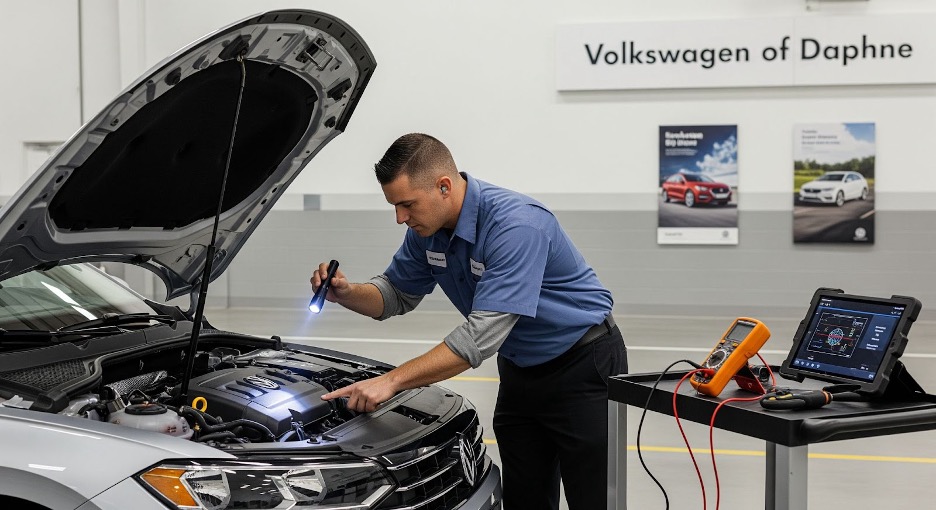
VW Engine Rattling Noise? Common Volkswagen Engine Sounds Explained
A VW engine rattling noise can come from something simple, such as a loose heat shield or aging belt, or something more serious, such as low oil pressure, spark knock, or internal engine wear. The sound itself matters. A light tick at idle is different from a deep knock under acceleration. A brief cold-start sound is different from a rattle that gets louder with RPM, appears with a dashboard warning light, or comes with smoke, rough running, or loss of power.
Volkswagen of Daphne created this guide for drivers in Daphne, Fairhope, Spanish Fort, Mobile, Foley, and Gulf Shores who want to understand common Volkswagen engine noises before scheduling service. Use the tables below to compare rattling, ticking, knocking, squealing, clunking, and pinging sounds, then decide whether your VW should be monitored, inspected soon, or stopped safely.
VW engine rattling is a noticeable sound from the engine bay or nearby components that may come from normal mechanical operation, loose hardware, oil-related wear, belt or pulley noise, exhaust vibration, combustion issues, or internal engine damage. The safest next step depends on when the noise happens, how loud it is, whether it changes with RPM, and whether warning lights or drivability symptoms appear.
Quick Answer: Why Is My Volkswagen Engine Making a Rattling Noise?
A Volkswagen engine may rattle because of a loose heat shield, worn belt or pulley, exhaust vibration, low oil, aging oil, spark knock, a turbo or accessory concern, or a deeper internal engine issue. If the sound is light, brief, and not paired with warning lights, it may be safe to monitor briefly. If the sound is loud, metallic, gets worse with acceleration, or appears with an oil warning, smoke, shaking, overheating, or power loss, we recommend stopping safely and scheduling diagnosis.
- Light ticking at idle: Often less urgent, but still worth verifying during service.
- Rattling under the vehicle: May point to a loose shield, bracket, or exhaust component.
- Knocking under acceleration: More urgent and should be inspected quickly.
- Squealing or chirping: May relate to belts, pulleys, or accessory components.
- Noise with warning lights: Stop guessing and schedule service guidance.
Table of Contents
- Common VW Engine Noises and What They Usually Mean
- Rattling, Ticking, Tapping, Knocking, and Squealing Compared
- Normal VW Engine Sounds vs Red Flags
- How Oil, Heat, and Maintenance Affect Engine Noise
- Should You Keep Driving or Stop?
- Jetta, Tiguan, Atlas, Taos, and Golf Engine Noise Tips
- Daphne, Fairhope, Spanish Fort, and Mobile Driving Conditions
- What Our Volkswagen Technicians Check First
- Key Takeaways
- VW Engine Rattling FAQ
Common VW Engine Noises and What They Usually Mean
Key Takeaway: The first SEO and service opportunity is to explain the sound type clearly. Drivers search for rattling, knocking, ticking, tapping, squealing, and clunking, but each sound points to a different diagnostic path.
When someone says, “My VW engine is rattling,” the first step is to make the sound more specific. A loose heat shield can sound like an engine rattle even when the engine itself is not the source. A light injector tick can sound alarming to someone who has not owned a modern Volkswagen before. A deep knock under acceleration is much more concerning than a brief tick after startup.
The timing of the sound matters too. A rattle during cold start may have a different cause than a rattle after a 40-minute drive from Mobile. A noise that happens only when accelerating can point to a different system than a noise that happens while idling in Fairhope traffic. A sound that appears after hitting road debris or driving through heavy rain may point us toward shields, belts, or underbody components.
Monitor Briefly
Light, brief sounds with no warning lights and no change in performance may be noted and verified during routine service.
Schedule Service Soon
New, repeated, RPM-related, or worsening sounds should be inspected before they become more expensive.
Stop Driving
Loud knocking, oil warnings, smoke, overheating, shaking, or power loss should be treated as urgent.
Rattling, Ticking, Tapping, Knocking, and Squealing Compared
Use this comparison table to describe the sound before scheduling service. You do not need to diagnose the part. You only need to explain what the noise sounds like, when it happens, and whether the vehicle still drives normally.
| Sound | Common Pattern | Possible Cause | Recommended First Step |
|---|---|---|---|
| Light ticking | Fast, even sound at idle or cold start | Direct-injection operation, valve-train sound, oil level, or normal mechanical sound | Monitor if brief, then ask our team to verify during service |
| Tapping | Sharper sound that may change with RPM | Oil level, oil age, valve-train concern, or internal wear | Check oil level safely and schedule inspection |
| Rattling | Loose vibrating sound from engine bay or below vehicle | Heat shield, exhaust bracket, loose hardware, belt area, or underbody component | Schedule a multi-point inspection |
| Squealing or chirping | High-pitched sound during startup, acceleration, rain, or accessory load | Belt, pulley, bearing, tensioner, or accessory-drive issue | Schedule belt and pulley inspection |
| Pinging | Light metallic sound under acceleration or load | Combustion, fuel, carbon buildup, sensor, or engine-management concern | Avoid hard acceleration and schedule diagnosis |
| Knocking | Deep metallic sound, often worse under load | Potential internal engine, combustion, oil-pressure, or severe wear issue | Stop driving if loud, persistent, or paired with warning lights |
| Clunking | Dull hit or movement sound during shifts, bumps, or load changes | Mount, accessory, exhaust, driveline, or suspension-related issue | Schedule inspection before more driving |
For a Daphne commuter hearing a faint tick during the first minute after startup, we recommend noting whether the sound fades as the engine warms. For a Spanish Fort Tiguan owner hearing a heavy knock while merging onto I-10, we recommend avoiding hard acceleration and scheduling diagnosis because load-related knocking can point to a more serious concern.
Schedule VW Engine Noise Service
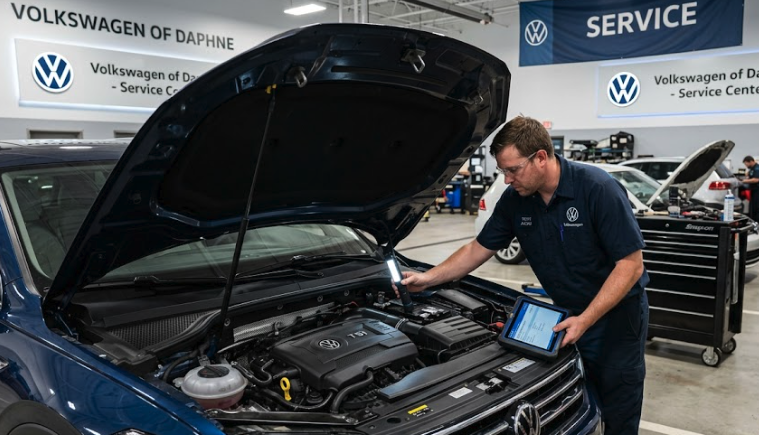
Normal VW Engine Sounds vs Red Flags That Need Service
Key Takeaway: A sound can be normal only when the pattern supports it. New, loud, worsening, metallic, or warning-light-related sounds should be inspected.
Modern Volkswagen engines can make normal operating sounds. Many VW models use direct injection, turbocharged components, cooling fans, emissions systems, and belt-driven accessories. A light ticking sound at idle, a brief cold-start sound, or a fan noise after shutdown may not automatically mean something is failing.
The red flags are different. We recommend service when the sound is new, loud, metallic, or worsening. We also recommend prompt inspection if the vehicle shakes, loses power, smells hot, leaks fluid, smokes, overheats, or shows an oil pressure, check engine, EPC, coolant, or charging-system warning.
| Sound Scenario | Less Concerning Pattern | Red Flag Pattern | Best Next Step |
|---|---|---|---|
| Cold-start tick | Brief, even, fades after warmup | Gets louder, continues after warmup, or appears with warning lights | Verify during oil service or diagnostic visit |
| Rattle under vehicle | Mild vibration over certain RPM range | Dragging, scraping, burning smell, or loud metallic sound | Inspect heat shields and exhaust hardware |
| Squeal or chirp | Brief sound on startup or damp conditions | Repeated sound with steering, A/C load, or acceleration | Inspect belts, pulleys, and accessory drive |
| Knock under acceleration | None that should be ignored | Deep knock, power loss, smoke, or flashing warning light | Stop driving and request service guidance |
For a Mobile Jetta commuter with a light tick and no warning lights, our service team may begin with an oil level check, service history review, and normal-operation comparison. For a Fairhope family driving a Tiguan that suddenly rattles hard in traffic, we recommend scheduling service sooner because heat and stop-and-go driving can reveal oil, belt, cooling, or vibration problems faster.
How Oil Condition, Heat, and Maintenance Affect VW Engine Noise
Key Takeaway: Oil level, oil age, and maintenance history are among the first items to check when a Volkswagen engine starts ticking, tapping, or rattling.
Oil is one of the first things we check when a Volkswagen engine noise comes into our shop. Low oil, old oil, incorrect oil specification, delayed maintenance, or a leak can make engine components sound louder because moving parts are not being protected the way they should be. Gulf Coast heat can make this more noticeable, especially during long commutes, school traffic, and summer road trips.
For a Fairhope driver who hears tapping after sitting in traffic, checking oil level and service timing is a smart first step. For a Foley driver who recently bought a used VW and does not know the last service date, a baseline oil service and multi-point inspection can help separate normal operation from a developing issue.
| Maintenance Factor | Why It Can Affect Noise | What Our Team Checks | Best For |
|---|---|---|---|
| Oil level | Low oil can increase friction and mechanical sound | Oil level, leaks, and oil-pressure concerns | Ticking, tapping, or oil warning concerns |
| Oil age | Old oil may not protect as well under heat | Maintenance history and oil condition | High-mileage commuters |
| Oil specification | Incorrect oil can affect protection and performance | Correct VW-approved oil for the specific model | Used VW buyers with unknown service records |
| Belts and pulleys | Wear can create chirping, squealing, or rattling | Belt drive, pulley bearings, and tensioner condition | Drivers hearing sound near the front of the engine |
| Heat shields and exhaust | Loose shields can mimic engine rattle | Underbody hardware, exhaust hangers, and brackets | Drivers hearing rattle below the vehicle |
Should You Keep Driving or Stop?
Key Takeaway: The safest decision depends on sound severity, warning lights, drivability changes, and whether the noise is getting worse.
Many VW engine noises are easier to diagnose when they are inspected early. A minor rattle can be a loose shield or bracket. A squeal can be a belt concern. A ticking sound can be related to oil condition or normal operating noise. A deep knock is different. Continuing to drive with a serious knock can turn a manageable problem into a major repair.
| Situation | Monitor Briefly | Schedule Service Soon | Stop Driving |
|---|---|---|---|
| Light tick at idle | Yes, if brief and no warning lights | Yes, if new, louder, or persistent | Only if warning lights or symptoms appear |
| Loose rattle from below vehicle | Only if mild and brief | Yes | Yes, if dragging, scraping, or very loud |
| Squealing belt sound | No long-term monitoring | Yes | Yes, if overheating, steering concern, or battery warning appears |
| Tapping that rises with RPM | No long-term monitoring | Yes | Yes, if oil light appears |
| Pinging under acceleration | Avoid hard acceleration | Yes | Yes, if severe or paired with power loss |
| Deep knocking | No | Call first | Yes |
If your VW knocks, shakes, smells hot, shows an oil warning, loses power, smokes, overheats, or makes a heavy metallic sound, we recommend stopping safely and contacting our service team before continuing.
Jetta, Tiguan, Atlas, Taos, and Golf Engine Noise Tips
Key Takeaway: Model-specific language helps capture long-tail search demand while giving owners more relevant service guidance.
| Volkswagen Model | Common Search Intent | Possible Noise Pattern | Recommended Next Step |
|---|---|---|---|
| Volkswagen Jetta | Volkswagen Jetta rattling noise, VW Jetta engine ticking | Light ticking at idle, tapping after startup, rattle during acceleration | Check oil level and schedule diagnosis if the sound repeats |
| Volkswagen Tiguan | VW Tiguan rattling noise when accelerating | Rattle under load, belt noise, heat shield vibration, engine knock | Avoid hard acceleration and schedule service if the noise persists |
| Volkswagen Atlas | VW Atlas engine knocking or rattling | Deep sound under load, family-trip noise, underbody rattle | Schedule diagnosis before longer travel |
| Volkswagen Taos | VW Taos engine noise, ticking, or rattle | Cold-start sound, idle tick, or RPM-related noise | Confirm service history and inspect if the sound is new |
| Volkswagen Golf or Golf GTI | VW Golf rattling noise when accelerating | Turbo, belt, heat shield, engine, or exhaust-related noise | Schedule inspection if the sound changes with throttle |
The best first step is not guessing the repair. It is matching the sound to timing, warning lights, service history, and driving behavior. Our technicians can use that information to decide whether the inspection should begin with oil condition, loose hardware, belt-drive components, diagnostic codes, or an engine performance test.
Daphne, Fairhope, Spanish Fort, and Mobile Driving Conditions
Key Takeaway: Gulf Coast heat, humidity, heavy rain, short trips, and I-10 acceleration can make Volkswagen engine noises easier to hear and more important to inspect early.
Local conditions matter. Around Daphne and Fairhope, short trips, school traffic, summer heat, and humid air can make oil condition, cooling performance, belts, and exhaust hardware more important. On I-10 toward Mobile, acceleration and engine load can reveal pinging, knocking, or belt-drive noise that may not show up during neighborhood driving.
| Local Driving Condition | Noise Risk | What We Check | Recommended Action |
|---|---|---|---|
| Daphne and Fairhope errands | Short trips may make cold-start sounds more noticeable | Oil level, service history, startup sound | Monitor if mild, service if repeated |
| Spanish Fort to Mobile I-10 driving | Acceleration can reveal pinging or knocking | Diagnostic scan and road-test pattern | Schedule service quickly |
| Gulf Coast summer heat | Heat can stress oil, belts, hoses, and cooling parts | Fluids, belts, fans, hoses | Pair oil service with inspection |
| Gulf Shores weekend trips | Long drives and vibration can expose loose components | Heat shields, exhaust hangers, underbody hardware | Inspect before the next trip |
| Rain and humidity | Moisture can make belt or accessory sounds more obvious | Belt condition and pulley area | Schedule service if the noise repeats |
If you drive from Fairhope, Spanish Fort, Mobile, Foley, or Gulf Shores, we recommend checking current service specials before booking your appointment. Our team can help pair the right service with the sound you are hearing, including oil service, battery checks, multi-point inspection, belt inspection, or diagnostic testing.
What Our Volkswagen Technicians Check First
Key Takeaway: A step-by-step inspection helps separate simple vibration issues from maintenance-related noises or more serious internal engine concerns.
When a VW arrives with an engine noise, our technicians do not jump straight to a worst-case repair. We begin with the basics because many noises are tied to oil level, service history, shields, brackets, belts, pulleys, mounts, exhaust vibration, or stored diagnostic codes.
| Inspection Step | What We Look For | Why It Matters | Best For |
|---|---|---|---|
| Oil level and condition | Low level, dark oil, overdue service, leaks | Oil problems can make engine sounds louder | Tapping, ticking, or maintenance concerns |
| Dashboard and code scan | Stored faults, warning-light history, misfire data | Electronic clues may point us to the right system | Noise with warning lights or rough running |
| Cold and warm listening check | Noise timing and temperature pattern | Some sounds appear only during startup or warm idle | Cold-start complaints |
| Belt and pulley inspection | Accessory noise, bearing wear, belt condition | Front-engine noises can sound like internal rattles | Chirp, squeal, or RPM-related sound |
| Exhaust and shield inspection | Loose heat shields, hangers, brackets | Simple vibration can mimic engine rattle | Rattle from underneath |
| Road test when appropriate | Noise under load, turning, braking, or acceleration | Some problems only show up while driving | Acceleration knock or clunk concern |
Before your appointment, write down when the sound happens, whether the engine is cold or warm, whether the sound changes with acceleration, and whether any dashboard warning appeared. That information helps us inspect your Jetta, Tiguan, Atlas, Taos, Golf GTI, or other Volkswagen more efficiently.
Ask Us About a VW Engine Sound
Key Takeaways
- A light VW engine tick can be normal, but a loud knock or warning-light event needs prompt service.
- Low oil, aging oil, loose shields, belts, pulleys, exhaust hardware, and internal concerns can all create rattling sounds.
- Noise under acceleration should be inspected quickly, especially if it is metallic or getting worse.
- Model-specific searches around Jetta, Tiguan, Atlas, Taos, and Golf are important opportunities for this page.
- Gulf Coast heat, humidity, traffic, and longer trips can make small maintenance issues easier to hear.
- Bring sound timing, temperature, acceleration, and warning-light notes to your service appointment.
VW Engine Rattling FAQ
Why is my Volkswagen engine making a rattling noise?
Your Volkswagen engine may be rattling because of a loose heat shield, exhaust vibration, belt or pulley wear, low oil, aging oil, spark knock, or an internal engine concern. A mild rattle may be less urgent, but a loud metallic rattle, knocking sound, warning light, smoke, or power loss should be inspected right away.
Is a ticking noise normal in a Volkswagen engine?
A light, even ticking sound can be normal in some modern Volkswagen engines, especially at idle or during cold start. If the tick is brief, steady, and not paired with a warning light, our team can verify it during routine service. If the ticking gets louder, changes with RPM, or appears with rough idle, oil warning, or loss of power, schedule service.
Can low oil make my VW engine rattle?
Yes. Low oil can make a VW engine sound louder because moving parts may not be getting the protection they need. Check the oil level only when it is safe to do so and schedule service if the level is low, the oil looks dirty, or the oil light appears. Do not continue driving with an oil pressure warning.
Why does my VW rattle when accelerating?
A VW rattling noise when accelerating may relate to exhaust vibration, a loose heat shield, belt or pulley wear, spark knock, turbo-related sounds, engine mounts, or internal engine stress under load. We recommend avoiding hard acceleration and scheduling diagnosis if the sound repeats or gets louder.
Should I drive my Volkswagen if the engine is knocking?
We do not recommend continuing to drive if your Volkswagen has a deep knocking sound, especially if the noise gets worse under acceleration or appears with a warning light, smoke, rough running, or power loss. Stop safely and call our service team for guidance.
What service should I schedule for a VW engine noise?
For most VW engine noise concerns, start with a diagnostic inspection or an oil change paired with a multi-point inspection, depending on the sound and service history. If the sound is loud, metallic, new, or paired with warning lights, schedule diagnostic service instead of basic maintenance only.
Why is my Volkswagen Jetta making a rattling noise?
A Volkswagen Jetta rattling noise may come from a heat shield, exhaust component, belt or pulley, oil-related issue, or engine-management concern. If the sound is light and brief, note when it happens. If it repeats, changes with RPM, or appears while accelerating, schedule service.
Why is my VW Tiguan making a rattling noise when accelerating?
A VW Tiguan rattling noise when accelerating may indicate a loose shield, exhaust vibration, belt-drive concern, engine mount issue, spark knock, or another load-related problem. Because acceleration noises can point to more serious causes, we recommend scheduling diagnosis if the sound repeats.
We know an unfamiliar VW engine sound can make every drive feel uncertain. Volkswagen of Daphne can help you identify whether the noise sounds like a monitor-it item, a service-soon concern, or a stop-driving situation. Visit us at 29816 Frederick Blvd, Daphne, AL 36526, call our service department at 228-291-2035, or schedule through our service appointment form. We proudly serve Volkswagen drivers from Daphne, Fairhope, Spanish Fort, Mobile, Foley, and Gulf Shores.

