

How the 2026 Volkswagen Atlas Fits Family Life
The 2026 Volkswagen Atlas provides 20.6 cubic feet of cargo room behind the third row, 55.5 cubic feet behind the second row, and up to 96.6 cubic feet with both rear rows folded. It seats up to seven with a second-row bench or up to six with available captain’s chairs.
For many Daphne-area families, the most useful setup is the five-passenger configuration with the third row folded. It keeps the first two rows available for passengers while opening enough room for strollers, sports bags, luggage, groceries, pet equipment, coolers, and beach supplies.
At Volkswagen of Daphne, we recommend choosing the Atlas layout based on the passenger and cargo combination your household uses every week, not only the maximum published capacity.
The 2026 Volkswagen Atlas is a three-row midsize SUV designed for families whose passenger and cargo needs change throughout the week. With all three rows upright, it can carry up to seven people and still provide a useful rear cargo area. Folding the third row transforms it into a spacious five-passenger vehicle, while folding both rear rows creates nearly 100 cubic feet of maximum cargo capacity.
At Volkswagen of Daphne, we help families from Daphne, Fairhope, Spanish Fort, Mobile, Foley, Gulf Shores, and nearby communities compare the Atlas with the Tiguan and Atlas Cross Sport. Our goal is to help you determine how many seats you genuinely need, which items you carry regularly, and which interior configuration makes daily life easier.
Ready to compare the space? View our new Volkswagen Atlas models , schedule an Atlas test drive , or begin with online pre-approval .
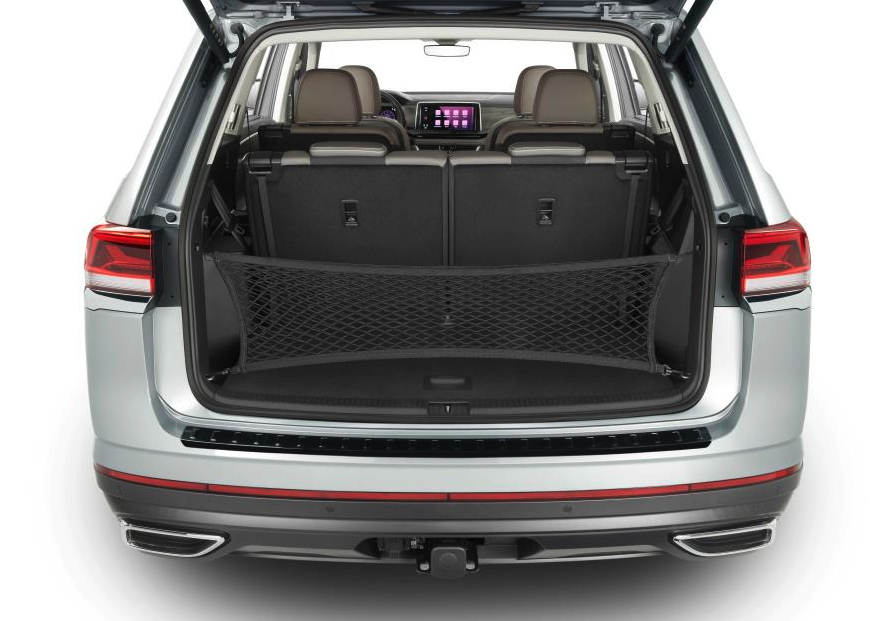
2026 Volkswagen Atlas Cargo Space Overview
The Atlas provides three practical cargo configurations, allowing families to prioritize seven-passenger seating, five-passenger travel, or maximum interior capacity.
Official cargo measurements provide an important starting point, but the most useful number depends on how many seats remain occupied. A family that carries six or seven people regularly needs to evaluate the area behind the third row. A household that usually carries four or five people will probably use the larger space behind the second row more often.
| Atlas Interior Configuration | Passenger Capacity | Official Cargo Volume | Practical Family Use | Best For |
|---|---|---|---|---|
| All three rows upright | Up to seven | 20.6 cu. ft. | Groceries, backpacks, compact luggage, smaller strollers, and daily supplies | Larger families that use every row regularly |
| Third row folded | Up to five | 55.5 cu. ft. | Strollers, sports gear, beach equipment, luggage, pet carriers, and larger shopping trips | Families of four or five with frequent cargo needs |
| Second and third rows folded | Two | 96.6 cu. ft. | Large boxes, camping gear, home-project supplies, bicycles, and moving-day loads | Drivers who occasionally need maximum capacity |
| One third-row section folded | Up to six | Variable | Longer equipment beside one third-row passenger | Families balancing passengers and sports gear |
| Second-row captain’s chairs | Up to six | Same published cargo volumes | Easier center-aisle access to the third row | Families prioritizing third-row access |
| Second-row bench | Up to seven | Same published cargo volumes | Adds one additional passenger position | Larger households and regular carpools |
Cargo measurements describe interior volume. They do not guarantee that every stroller, pet carrier, bicycle, or piece of furniture will fit because shape, height, width, and liftgate-opening dimensions also matter.
2026 Atlas Cargo Space Behind the Third Row
With every seat available, the 2026 Atlas provides 20.6 cubic feet behind the third row. This is the configuration families should study most carefully if they expect to carry six or seven people on a regular basis.
This rear area is designed for daily cargo rather than maximum-capacity hauling. Depending on the dimensions of the actual items, it can support grocery bags, school backpacks, compact luggage, smaller coolers, sports bags, and some folded strollers.
For a family that regularly uses all three rows, we recommend bringing the largest item used each week to the test drive. A compact travel stroller may fit easily, while a full-size double stroller may require one section of the third row to fold.
Why the Split-Folding Third Row Matters
The third row uses a 50/50 split, which lets the Atlas carry one third-row passenger while using the other side for longer cargo. This mixed configuration is especially helpful for sports families, airport trips, or beach travel.
- Keep one rear seat upright for an additional passenger.
- Fold the other side for folding chairs, sports bags, or longer luggage.
- Preserve second-row seating for child restraints or adult passengers.
- Avoid stacking equipment high enough to obstruct rearward visibility.
2026 Atlas Cargo Space Behind the Second Row
Folding the third row expands the Atlas cargo area to 55.5 cubic feet while preserving seating for up to five people. For many families, this is the most useful daily configuration.
A family of four traveling from Daphne to Gulf Shores can keep everyone in the first two rows while using the rear area for luggage, beach chairs, a cooler, towels, shade equipment, and other supplies. A Fairhope sports family can use the same layout for equipment bags, folding chairs, uniforms, water containers, and groceries after practice.
This configuration also works well for airport trips. Five passengers can remain seated while the third row stays folded for luggage. Because rigid suitcases use space differently from flexible bags, we recommend checking the dimensions of your largest suitcase before a long trip.
Best Uses for the Third-Row-Folded Layout
- Family road trips with four or five passengers.
- Youth sports practices and tournaments.
- Gulf Shores and Foley weekend travel.
- Pet travel with a properly secured carrier.
- Large weekly grocery or warehouse-store trips.
- Mobile or Pensacola airport transportation.
Maximum 2026 Atlas Cargo Space and Interior Flexibility
With the second and third rows folded, the Atlas offers up to 96.6 cubic feet of maximum cargo capacity. This arrangement leaves seating for two and creates the largest available interior load area.
The maximum configuration can help with college move-in days, furniture boxes, home-project materials, camping equipment, large pet supplies, bicycles after appropriate preparation, or other occasional loads that would overwhelm a smaller crossover.
Cargo volume does not equal payload capacity. Heavy objects must stay within the vehicle’s weight limits and should be positioned low, secured properly, and kept from moving during braking or cornering.
Measure These Items Before Your Atlas Test Drive
- The folded width, height, and length of your stroller.
- The dimensions of your largest pet carrier.
- The longest sports bag or beach item you transport.
- The number and size of suitcases used for family travel.
- The positions required for child safety seats.
- The number of passengers who use the third row weekly.
How the 2026 Atlas Fits Everyday Family Life
The Atlas is most useful for families whose routines change from day to day. It can serve as a three-row carpool vehicle in the morning, a five-passenger cargo carrier after school, and a road-trip SUV on the weekend.
| Driver Profile | Typical Scenario | Recommended Atlas Layout | Why It Works |
|---|---|---|---|
| Family of seven | School, errands, and weekend activities | Second-row bench with all rows upright | Preserves maximum passenger capacity |
| Family of four | Gulf Shores beach weekends | Third row folded | Provides 55.5 cu. ft. for bags, chairs, and a cooler |
| Youth sports household | Practices and tournaments around Baldwin County | Third row folded or split | Balances equipment space with changing passenger needs |
| Airport traveler | Five passengers with luggage | Third row folded | Keeps the second row available and opens luggage space |
| Pet-owning family | Vet visits and coastal weekends | Third row folded with secured carrier | Creates room for the carrier, food, and supplies |
| Carpool parent | School pickup with changing passenger counts | Bench or captain’s chairs based on capacity | Bench adds a seat; captain’s chairs improve access |
For most families of four or five, we recommend keeping the third row folded during normal daily driving. That layout provides the passenger room used most frequently while opening a broad, practical cargo floor for regular family equipment.
- If you carry seven people frequently, choose the second-row bench.
- If third-row access is the priority, consider available captain’s chairs.
- If your family usually carries four or five people, keep the third row folded for daily cargo flexibility.
- If you transport wet or muddy equipment, consider genuine Volkswagen cargo protection accessories.
2026 Volkswagen Atlas vs Tiguan for Family Space
The Tiguan is a practical five-passenger SUV for smaller families, commuting, parking, and lighter cargo needs. The Atlas is the stronger choice when a third row, greater maximum cargo capacity, or frequent group travel is essential.
| Family Decision Factor | 2026 Volkswagen Atlas | 2026 Volkswagen Tiguan | Why It Matters |
|---|---|---|---|
| Maximum Seating | Up to seven | Five | Atlas supports larger households and carpools |
| Third Row | Standard three-row layout | Not offered | Atlas carries extra passengers without another vehicle |
| Cargo Behind Final Row | 20.6 cu. ft. behind third row | 33.8 cu. ft. behind second row | Tiguan has more cargo room with every seat occupied, but carries fewer people |
| Maximum Cargo Capacity | 96.6 cu. ft. | 69.8 cu. ft. | Atlas supports larger household and travel loads |
| Parking and Maneuverability | Larger exterior footprint | More compact exterior | Tiguan can be easier to park in tighter spaces |
| Road-Trip Fit | More passenger and cargo flexibility | Well suited to smaller groups | Atlas handles larger families and more equipment |
| Best For | Growing families, carpools, sports, and large trips | Couples, smaller families, and daily commuting | The choice depends on regular seating needs |
We recommend the Atlas for growing families that regularly need more than five seats or carry bulky equipment. We recommend the Tiguan for households that do not need a third row and prefer a smaller vehicle for everyday driving.
Atlas Family Use Around Daphne and the Eastern Shore
Daphne families often combine several driving needs in one day. A routine can include school drop-off, a commute toward Mobile, a grocery stop, and evening sports practice. The Atlas lets families change the interior layout without replacing the vehicle for each task.
For commuters using I-10 and the Bayway, the Atlas provides a turbocharged engine rated at 269 horsepower. Available 4MOTION all-wheel drive can help manage traction as Gulf Coast rain changes road conditions, although drivers must still adjust speed, following distance, and tire condition.
For Fairhope households traveling on US-98, the larger cabin helps separate passengers from groceries, school bags, and sports equipment. Families heading toward Foley or Gulf Shores can fold the third row and use the larger cargo area for coolers, chairs, luggage, towels, and beach supplies.
| Local Driving Situation | Atlas Feature or Layout | Practical Benefit | Best For |
|---|---|---|---|
| Daphne school and sports schedule | Three rows and split-folding third row | Balances passengers with equipment | Carpool and youth sports families |
| Mobile Bayway commute | 269-hp turbo engine and available IQ.DRIVE | Supports highway merging and repetitive travel | Daily Mobile commuters |
| Fairhope grocery and errand runs | 55.5 cu. ft. with third row folded | Provides a wide area for weekly family loads | Families of four or five |
| Gulf Shores beach weekend | Flexible cargo floor and available accessories | Helps separate wet and bulky gear | Coastal weekend travelers |
| Mobile or Pensacola airport trip | Five seats plus 55.5 cu. ft. of cargo room | Supports passengers and multiple suitcases | Family vacation travel |
| Heavy Gulf Coast rain | Available 4MOTION all-wheel drive | Adds traction support as conditions change | Wet-weather commuters |
Our location at 29816 Frederick Boulevard makes it convenient for drivers from Daphne, Spanish Fort, Fairhope, Mobile, and nearby Eastern Shore communities to compare the Atlas seating arrangements and cargo floor in person.
What Actually Fits Inside a 2026 Volkswagen Atlas?
Cargo capacity helps compare vehicles, but real fit depends on item dimensions. A compact stroller and a full-size double stroller may both be called strollers, yet they use very different amounts of space.
Planning Examples by Seat Configuration
- All rows upright: groceries, backpacks, compact luggage, smaller coolers, and some compact strollers may fit depending on dimensions.
- Third row folded: larger strollers, multiple sports bags, beach chairs, pet equipment, and family luggage become easier to arrange.
- Both rear rows folded: large boxes, camping gear, bicycles after preparation, and home-project materials can use the maximum cargo area.
- One third-row side folded: longer cargo can sit beside one additional passenger.
The 50/50 split third row may be more useful than maximum cargo capacity for many households. It allows families to carry one rear passenger and one longer item at the same time, which reflects real weekend and sports travel more accurately than an all-seats-folded measurement.
Captain’s Chairs or Second-Row Bench in the Atlas?
The second-row bench preserves the Atlas’s maximum seven-passenger capacity. Available captain’s chairs reduce total capacity to six but create a center aisle that can make third-row access easier.
Choose the Second-Row Bench If:
- Your household may need all seven seats.
- Three passengers frequently sit in the second row.
- You participate in regular school or activity carpools.
- The additional seating position matters more than an aisle.
Choose Captain’s Chairs If:
- Children or adults enter the third row frequently.
- A center walkway would simplify passenger movement.
- Separate second-row seating improves trip comfort.
- Your family rarely needs a seventh passenger position.
Families using child safety seats should test the intended arrangement before choosing. A child restraint may affect how the second-row seat moves for third-row access. Always follow the vehicle owner’s manual and the child-restraint manufacturer’s instructions.
Atlas Family Technology, Safety, and Convenience
Family usefulness extends beyond seating and cargo. Available Atlas technology can help drivers manage commuting, parking, passenger comfort, and long-distance travel.
Family-Focused Atlas Features
- Available IQ.DRIVE driver assistance technology.
- Available 4MOTION all-wheel drive.
- Digital Cockpit display.
- Wireless smartphone connectivity.
- Available three-zone automatic climate control.
- Available heated and ventilated seating.
- Available panoramic sunroof.
- Power liftgate availability depending on trim.
Driver assistance systems support the driver but do not replace attentive driving. Exact equipment varies by trim and configuration, so we recommend confirming each feature on the specific Atlas you are considering.
Atlas Service, Maintenance, and Cargo Protection
Family vehicles often experience frequent short trips, heavy passenger use, coastal humidity, sand, wet equipment, and repeated loading. Routine maintenance and interior protection help keep the Atlas ready for those demands.
Common Atlas Ownership Needs
- Oil and filter changes.
- Tire rotations and tire inspections.
- Brake inspections.
- Battery testing.
- Cabin air filter replacement.
- Engine air filter replacement.
- Fluid checks.
- Factory-recommended scheduled maintenance.
Our service team can help you follow the maintenance schedule for your Atlas. Our parts department can also help identify genuine Volkswagen cargo mats, liners, organizers, and other accessories suited to your configuration.
You can schedule Volkswagen service online when your Atlas is due for maintenance.
Compare the 2026 Volkswagen Atlas in Daphne, AL
The 2026 Atlas gives families a flexible combination of three-row seating, usable cargo room, highway performance, available all-wheel drive, and modern driver assistance. Its strongest advantage is the ability to change from a seven-passenger SUV to a five-passenger cargo vehicle or a two-passenger maximum-capacity carrier.
At Volkswagen of Daphne, we can help you compare the bench and available captain’s chairs, test the third-row access, fold each seating section, and place your actual equipment inside the cargo area. We can also compare the Atlas with the Tiguan or Atlas Cross Sport if you do not need three rows.
Visit us at 29816 Frederick Boulevard, Daphne, AL 36526, or call our team at 251-374-0664. We serve families from Daphne, Fairhope, Spanish Fort, Mobile, Foley, Gulf Shores, and nearby Gulf Coast communities.
Frequently Asked Questions About 2026 Volkswagen Atlas Cargo Space
How much cargo space does the 2026 Volkswagen Atlas have?
The 2026 Volkswagen Atlas provides 20.6 cubic feet of cargo room behind the third row, 55.5 cubic feet behind the second row, and 96.6 cubic feet with the second and third rows folded. We recommend evaluating the configuration your family will use most often rather than relying only on maximum capacity.
Can adults sit in the third row of a Volkswagen Atlas?
The Atlas has a functional third row intended for regular passenger use. Comfort depends on passenger height, second-row position, and trip duration. We recommend having the adults or teenagers who will use the third row sit there during the test drive.
Is the Volkswagen Atlas or Tiguan better for a growing family?
We recommend the Atlas for families that need more than five seats, regularly carry bulky sports or travel equipment, or want a third row available for carpools and relatives. The Tiguan is better suited to households that need five seats and prefer a more compact exterior.
Should we choose captain’s chairs or the Atlas bench seat?
Choose the second-row bench when seven-passenger capacity or three-across second-row seating is essential. Choose available captain’s chairs when easier third-row access and separate seating matter more than the seventh passenger position.

